
Why sign placement matters more than sign size alone
Many sites spend money on clear wording and bright colours, then mount the sign in a spot where it is blocked by a parked truck, a stack of pallets, or a door that swings over it. If the message is hidden, the sign has failed before anyone even reads it. Good visibility is about sight lines, height, contrast and the route people actually use.
On mines, schools and industrial yards across Bojanala, movement is constant. Staff arrive early, drivers reverse in tight spaces, and contractors often come in from side gates. A warning sign must meet them at the point of decision, not after they have already stepped into the danger area. That means thinking about where people walk, where vehicles turn, and where visitors naturally look when they slow down.
Start with the route, not the wall
Before fixing a sign, walk the site and follow the same path a first-time visitor would take. Stand at the gate, the loading bay, the workshop entrance and the pedestrian route. Ask where the eye is drawn first. In many cases the best place is not the nearest open wall, but the point where someone pauses, turns or waits.
- Put entry warnings at eye level near gates and turnstiles.
- Place directional safety signs before intersections, not after them.
- Use repeated signs on long fences if the site stretches over a wide area.
- Avoid mounting signs behind trees, pipes, stacked stock or security fencing that cuts the message in half.
If a person has to stop and scan the area before understanding the message, the placement is already too late. Keep the sign in the path of natural movement. On busy yards in Rustenburg CBD or around Marikana, that often means placing signs where the driver lines up to reverse and where pedestrians gather before entering a controlled area.
Use height and angle to beat glare and clutter
Visibility is not only about what the sign says, but how it faces the viewer. A sign mounted too high can be missed by a pedestrian. One mounted too low can disappear behind equipment or be damaged by bumping trolleys. The best position depends on whether the viewer is walking, driving or working from a machine.
For pedestrian warnings, a centre point around eye level usually works best. For vehicle routes, signs may need to sit higher so they remain clear above bonnets, trailers and load beds. Coastal humidity is not the issue in Rustenburg, but dust, sunlight and vibration are. A sign fixed at the wrong angle can pick up glare in the morning or afternoon and become hard to read. We often see this on north-facing walls or under bright security floodlights where reflections make a simple warning hard to catch.
A good rule is to stand where the viewer stands and tilt the sign until it reads cleanly from that position. If the wording is only readable when you move closer than is safe, it needs to be moved or resized.
Match the sign to the risk point
Every warning sign should sit as close as practical to the hazard it refers to. A slippery floor sign belongs near the wet area, not at the far end of the passage. A no-entry sign should be at the actual boundary, not inside the restricted zone. This sounds simple, yet it is one of the most common mistakes on site.
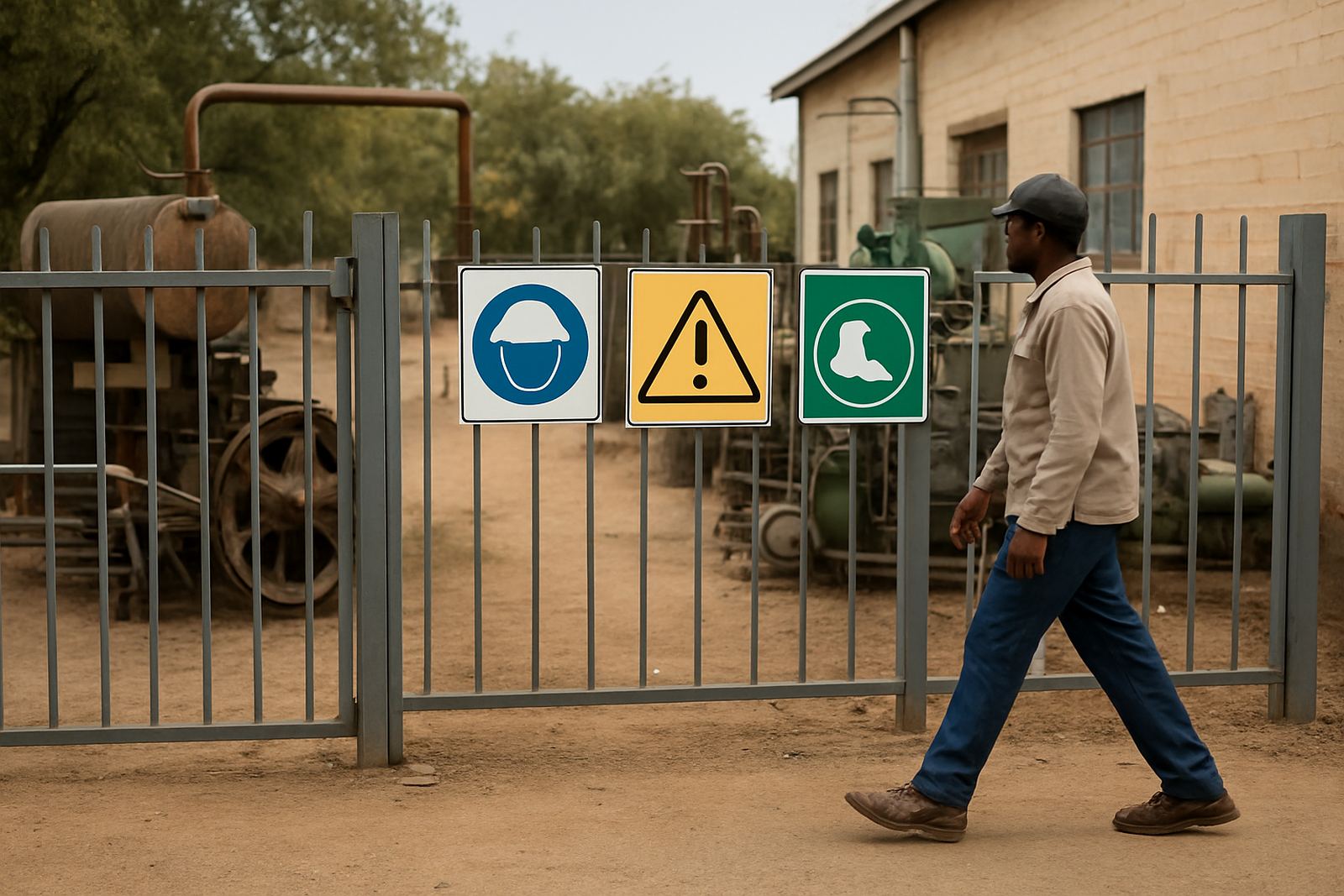
For local operations, that could mean placing fire notices near generators, chemical warnings near storage cages, and hard hat signs at the access point before the work area begins. Where there are multiple risks in one zone, use a clear sequence so people can read the message in the right order. First the restriction, then the hazard, then the action required.
- Keep warning signs within a short walking distance of the risk.
- Repeat signs at approach points if the area has more than one entry.
- Use arrows or direction markers where the danger is not directly visible.
- Replace faded or damaged signs before they start blending into the background.
On construction and maintenance jobs, temporary signs should be placed where workers are likely to enter from, not just where the supervisor happens to stand. That small shift in placement can stop confusion and save time on the floor.
Think about lighting, dust and load shedding
Sites in and around Rustenburg often deal with power cuts, patchy lighting and dust from vehicle movement. A sign that looks fine in daylight may disappear at dusk when the area depends on a few security lamps. For this reason, reflective material, strong contrast and simple wording matter just as much as where the board is fixed.
During load-shedding, people rely more on torchlight, vehicle headlights and emergency lights. That means your sign must still be readable under low light. Avoid long sentences and crowded layouts. Keep the main instruction big enough to read quickly, because in dim conditions nobody has time to work out a complicated message. Also, if the site gets dusty, choose finishes that can be wiped clean without damaging the print.
If the sign must be seen at night, test it from the same angle a driver or security guard will use. A sign that works in the office can fail at the gate after dark, and that is when it matters most.
A Rustenburg example from a mixed industrial site
Consider a mixed site near Rustenburg where a delivery truck enters, staff cross a yard on foot, and maintenance teams work near a service bay. At first the warning boards were placed on the building wall behind the loading area. The signs were neat, but they were not being seen because stacked pallets and parked bakkies blocked the view. The warning message was there, but not in the line of sight.
After reviewing the site flow, the signs were moved to the entry gate, the pedestrian route and the edge of the service bay. Extra boards were added at the turning point where vehicles slow down. The result was simple: people saw the warning earlier, and the site felt more organised. No major redesign, just better placement.
That same approach works for schools, workshops and mine support areas across Bojanala. When the route is clear, the sign can do its job. When the route is messy, even the best printed board gets lost.
A quick checklist before you fix the next sign
Before drilling holes or applying adhesive, check the following points on site. A few minutes of planning can prevent a sign being moved later or becoming an expense that never really works.
- Can the sign be seen from the normal approach direction?
- Is it at the right height for the person who needs to read it?
- Will vehicles, doors, gates or stock block it during daily use?
- Does the lighting make it readable in the early morning or after dark?
- Is it close enough to the hazard to be useful, but not so close that it is hidden by the risk itself?
Good placement is often a practical job, not a fancy one. It comes down to watching how people move and fixing the sign where that movement naturally happens. If you get that right, the message stands a much better chance of being seen, read and acted on.