
Start with viewing distance, not with the artwork
A banner should be sized from the place where it will be read, not from the file on the screen. If people are walking past within a few metres, smaller text can work. If the banner faces traffic on a main road or a yard gate, the message must be larger and simpler. The biggest mistake is putting too much detail onto a size that is too small.
As a rule, the farther away the viewer stands, the fewer words should appear. A banner for a reception wall may carry a full message, but a roadside banner should focus on one clear line, a logo and contact or event details. In strong North West sun, contrast matters as much as size.
- Close viewing: short message, smaller format
- Mid-range viewing: larger lettering and fewer lines
- Long-range viewing: one main message only
Gate banners need quick reading at speed
At gate entrances, security points and mine access roads, people do not stop to read long copy. They pass through, sometimes in poor light or dusty conditions. A gate banner should be large enough to catch attention in a few seconds, with the main message set high enough to avoid being hidden by vehicles, fencing or booms.
For Rustenburg industrial sites and school entrances, a common approach is to use a banner that is wide rather than tall. That gives the sign more presence across a fence line and keeps the wording simple. If the banner is for repeated use, it helps to allow enough border space for eyelets or rope tying, especially where the wind picks up in open areas.
- Choose a wide format for fence lines and entrances
- Keep text short and bold
- Allow margin space for fixing points and hems
Hall and stage banners need balance, not just size
Indoor banners at school halls, church functions and company events are often viewed from only one direction, but they need to sit neatly behind a podium, stage or display table. Too small and they disappear in photos. Too large and they crowd the space or hang awkwardly against the wall. The banner size must match the room height as much as the wall width.
For indoor use, it is worth checking where lighting falls. A banner placed under bright hall lights can shine badly if the surface is too glossy, while a fabric or matte finish may suit better. For events in Bojanala where the same banner may be used at several venues, a medium size often gives the best return because it can be reused for both small and larger rooms.
- Match banner height to the wall or stage backdrop
- Allow enough space for speaker stands and tables
- Use a finish that suits indoor lighting
Roadside banners must compete with traffic and weather
Roadside banners are read under pressure. Drivers have only a moment to see the message, and wind can move a banner enough to make it harder to read. On exposed routes around Rustenburg, Tlhabane, Phokeng and the surrounding mining areas, the size needs to work with the speed of passing vehicles and the strength of the fixing points.
A banner that faces traffic should use large lettering, strong colour contrast and enough open space around the text. If the banner is too small, the viewer must slow down to read it, which rarely happens. In dusty or coastal-weather affected conditions further west, print quality and finishing matter because dirt and moisture can shorten the life of a poorly made banner.
- Use larger lettering for vehicles and fast-moving traffic
- Keep the message simple and direct
- Ask for reinforced edges where the banner will face wind
Event banners should be sized for photos and foot traffic
At markets, sports days, promotions and community events, banners are seen from several angles. Some people stand right in front of them, while others only catch a glimpse as they move past. The right size depends on whether the banner is meant to frame a stand, guide people to a table or carry a sponsor message across a busy area.
A banner used for event branding should be visible in photographs without overwhelming the setting. If it sits behind a gazebo or display table, the width should normally extend beyond the table so the message remains readable. For a one-day function, lightweight material can be practical, but the size still needs to suit the area so it does not flap and crease. Small details matter here, because one loose banner can make a whole setup look untidy.
- Use wider banners behind tables or gazebos
- Choose size based on the busiest viewing angle
- Leave space for photo backdrops and foot traffic
Finishing choices affect the size you should order
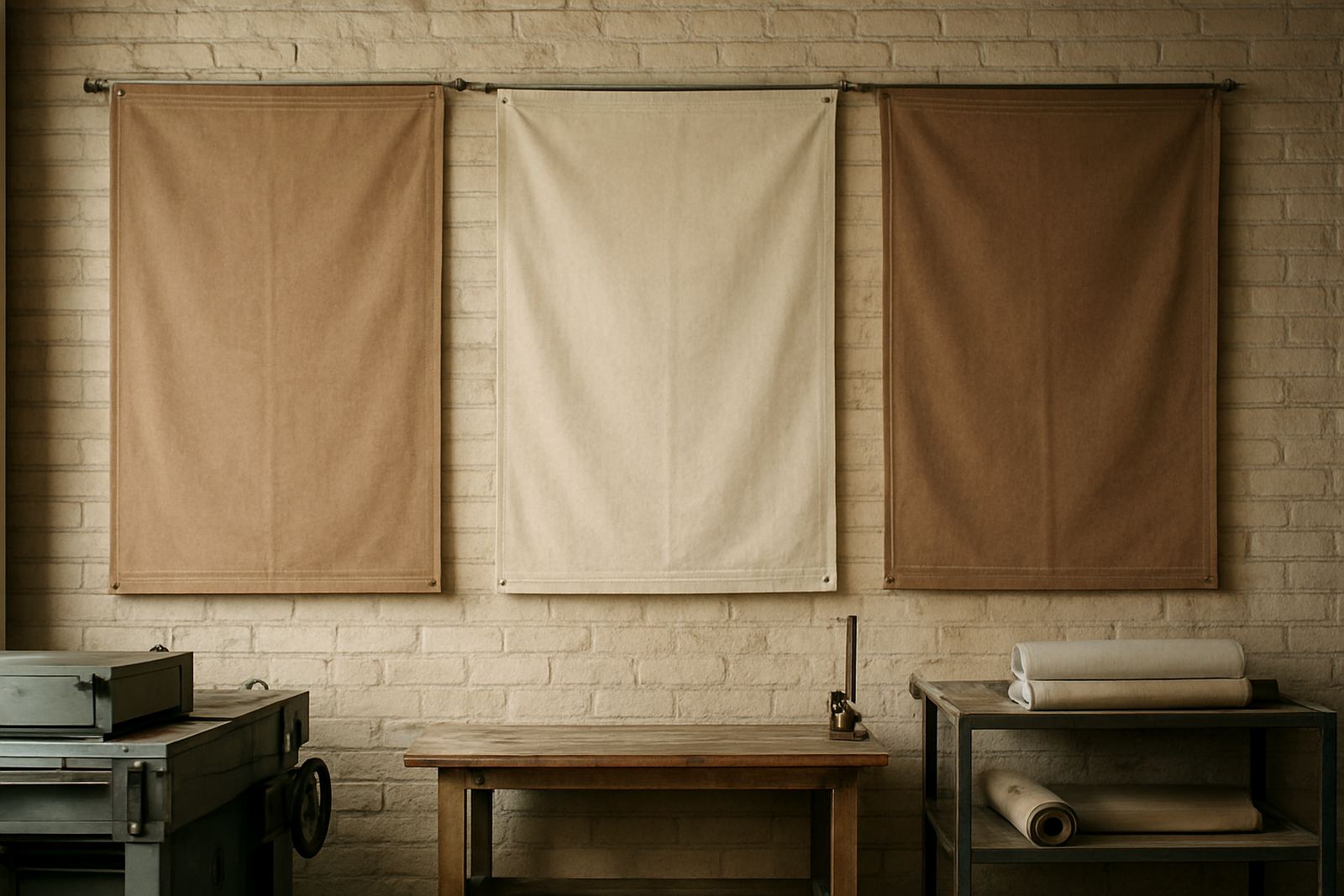
Banner size is not only about width and height. The finish affects how the banner hangs, how it travels and how long it lasts. A larger banner may need extra support points, heavier hemming or stronger corners to keep it flat. Smaller banners can be easier to move between branches or events, but they still need proper finishing if they are going outside.
When we prepare banners for Rustenburg businesses, mines, schools and site teams, we look at the full use case. Will the banner be up for one day or six months? Will it hang on a wall, fence or frame? Will it be folded and stored between uses? These questions matter because a banner that is the right size but badly finished still gives trouble later.
- Ask how the banner will be fixed in place
- Match the finish to the weather and duration
- Plan for storage if the banner will be reused
A local example: choosing the right size for a Rustenburg school event
A school in Rustenburg CBD needed a banner for prize-giving in the hall and another for the entrance gate outside. The hall banner had to sit behind the stage without blocking the speakers, while the gate banner had to be read by parents arriving by car and taxi. The two spaces needed different sizes, even though the event was the same.
For the hall, a wider banner with a neat centre message worked best because it appeared clearly in photographs and fitted above the stage line. For the gate, a taller, simpler banner made more sense because it had to be seen from the road and at the entrance point. That is the key point when choosing banner sizes: the message may be the same, but the viewing conditions are not.
If you are unsure, measure the space, note the viewing distance and think about where people will stand or drive. That small bit of planning saves money and gives a cleaner result the first time.