
Why gazebo space matters at busy Rustenburg venues
At active venues, a gazebo is not only a cover from sun and drizzle, it becomes a working point for sales, registration, product handouts or security screening. If the footprint is too tight, staff have no room to move, visitors bunch up at the front, and your side walls take the bumps from trollies, cool boxes and passing feet.
In Rustenburg and across Bojanala, many setups happen on hard ground, gravel or uneven paving. That means you must think about the gazebo size itself plus the extra space around it for ropes, weights, tables and queue movement. A 3 m x 3 m gazebo may fit on paper, but once you add people and stock, you need a bigger practical area. It is often the small bit of extra planning that keeps the day running cleanly.
For branded gazebos, space also affects how well the print is seen. If the front edge is pressed against a wall or parked vehicle, your logo loses visibility. At a school sports day or a mine induction point, clear sight lines matter because people need to spot you fast.
Start with the footprint, then add working room
The first step is to measure the actual gazebo footprint. Most event gazebos used for promotions or point-of-sale work are 3 m x 3 m, 3 m x 4.5 m or 3 m x 6 m. That is only the covered area. You should then allow extra space for safe access on all sides, especially if the gazebo will be used for serving people, displaying stock or sheltering equipment.
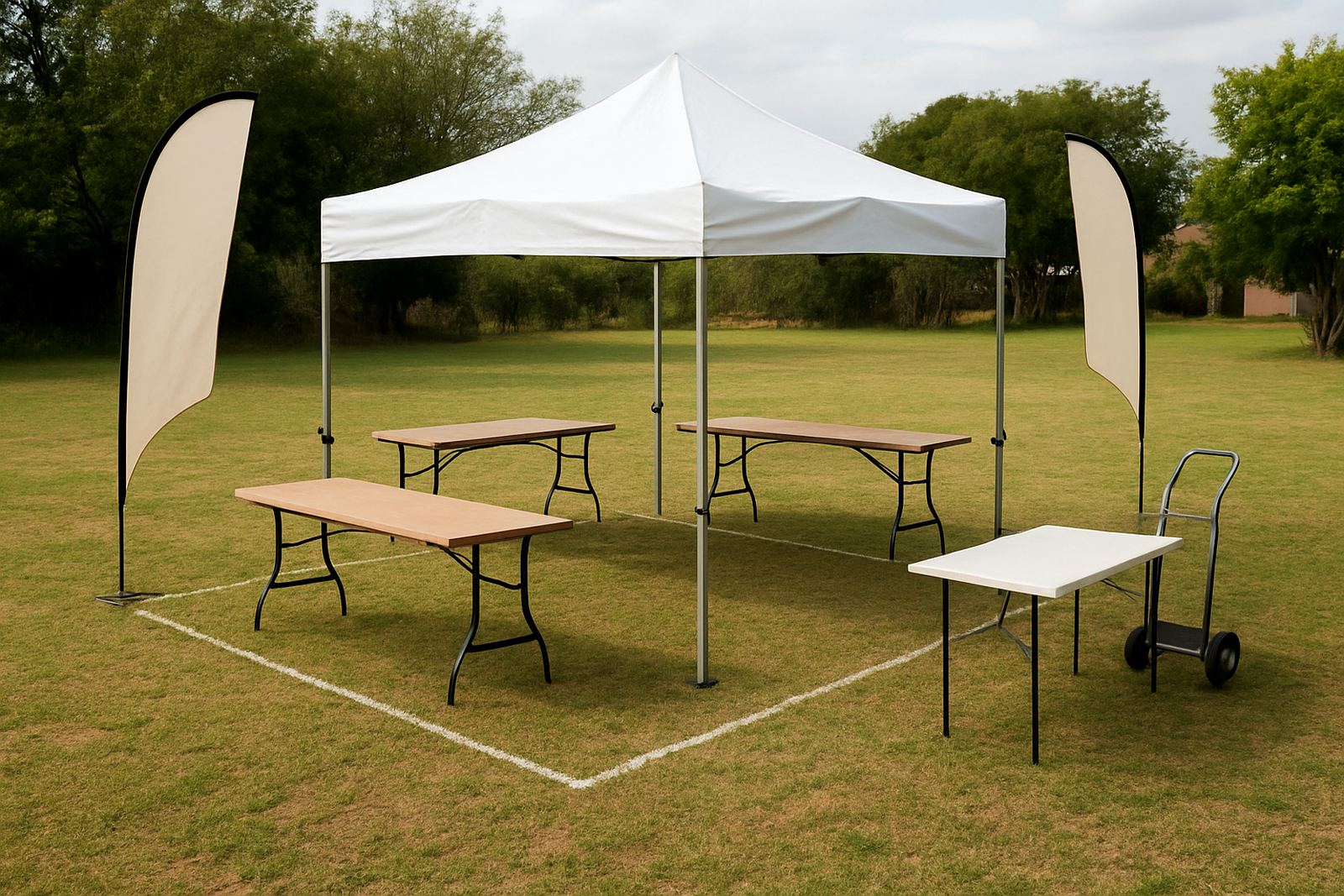
As a simple guide, allow at least 1 m clearance around the sides where staff need to move, and 1.5 m to 2 m at the front if the stand will have queues. If the setup includes tables, a banner frame or a branded backdrop, you need even more room. A cramped stand can look unplanned, and it makes daily work harder.
- 3 m x 3 m gazebo: aim for about 5 m x 5 m usable space where possible.
- 3 m x 4.5 m gazebo: allow closer to 5 m x 6.5 m.
- 3 m x 6 m gazebo: plan for a wider bay or an edge position with traffic on one side only.
- Add extra room for vehicle access, generator placement or storage boxes.
What to check before the gazebo arrives on site
Many problems start before the first pole is lifted. The venue may have poles, low branches, parking lines, kerbs, uneven slab edges or strict rules about where temporary structures may stand. In public areas and school grounds, you also need to think about fire lanes, pedestrian flow and whether the gazebo can be anchored properly without causing damage.
On mine sites and in industrial yards, the ground can be compacted gravel with strong wind tunnels between buildings. There, the usable space is not just about the width of the stand but about where the wind hits it. A gazebo placed too close to a wall can bounce gusts back under the roof, which puts strain on the frame and side panels. If the venue is coastal or exposed, the choice of weights and anchor points matters even more.
Before setup day, confirm these points with the venue manager or site contact. It saves time and avoids last-minute moving around.
- Exact standing area in metres, not only a rough description.
- Whether pegs, sandbags or water weights are allowed.
- Any height limits, access gates or load-in times.
- Whether the gazebo must stay clear of exits, hydrants or walkways.
Space for branding, tables and queue control
A gazebo used for branding needs more than a roof. If you are adding printed walls, a counter, stackable stock crates, hanging samples or branded gifts, each item takes up floor space. Once the first customer steps up, the front area must still feel open enough for the next person to wait without blocking the display.
For a front-facing promotional stand, leave the back wall for stock and the side wall for staff movement. Keep a clear path from the entrance of the gazebo to the main service point. If you are doing embroidery drop-offs, PPE issue, or branded gift handout, use a simple left-to-right flow so visitors know where to stand.
A practical way to plan your gazebo footprint:
- One folding table needs about 0.75 m x 1.8 m, plus chair space if staff are seated.
- A counter or display table should not sit flush against the entrance edge.
- Keep bag storage and stock off the walking line so people do not trip.
- If you are using a banner wall behind the gazebo, check that it does not block ventilation or block access to the side entry.
Local example: a school sports day in Rustenburg
Picture a school sports day in Rustenburg CBD or out towards Phokeng. The organiser wants a branded gazebo for registration, water handouts and sponsor material. The stand itself may only be 3 m x 3 m, but the practical space needed is wider because learners, parents and staff are moving through the area all day. If the gazebo is set too close to the track barrier, people will press into the front edge and the side panel will catch constant bumps.
A better setup is to place the gazebo where it has clear access from the side, with enough open ground in front for a queue and enough space behind for boxes and replacement stock. If the day is windy, the team should also avoid setting it in a direct channel between buildings. In Rustenburg weather, you can go from dry heat to a blustery afternoon quicky, so the setup has to cope.
For this kind of event, a simple layout might include:
- 3 m x 3 m gazebo with 1 m clearance on the rear and one side.
- 2 m to 3 m of open queue space in front.
- Weighted corners on all legs.
- One clear entry point and one working side for staff.
Wind, rain and heat are part of the size decision
In North West conditions, gazebo planning is not only about fitting into a marked area. Heat, sudden rain and wind all change how much room you should allow. A gazebo needs enough surrounding space for safe anchoring and for people to move away if the weather turns rough. If the stand is squeezed between vehicles or walls, it becomes harder to secure properly.
Sun exposure also matters. When a gazebo is packed tightly next to another structure, air cannot move freely and the inside becomes hotter. That affects staff comfort, print visibility and even the condition of stock. If you are showing printed garments, branded caps or promotional gifts, a little extra space helps protect the items and keeps the stand looking neat.
For outdoor events, we usually advise clients to plan for more room than the minimum. It is better to have one side open than to force the frame into a tight gap and hope for the best. That way the gazebo works as it should, even when the venue gets busy.
Getting the setup right before event day
The cleanest gazebo setup starts with a proper site check. Measure the area, mark the corners and confirm how people will enter and exit. If the gazebo is going to be used regularly at different venues across Bojanala, keep a simple site note for each one so the next installation runs faster. That includes the floor type, typical wind direction, nearest power point and where the vehicle can unload.
Crystal Clear Printing helps with branded gazebos, banner finishing, signage and delivery plus setup for Rustenburg, Tlhabane, Phokeng, Kroondal, Boshoek, Marikana, Mooinooi and Mogwase. For active venues, the right setup space is not a luxury, it is part of getting good use out of the structure and keeping the brand visible all day.
If you are planning a gazebo for a school, mine, market day or company activation, the best next step is to measure the site properly and leave enough room for people, stock and weather. A well placed gazebo works harder and lasts longer.