
Start with the site before you choose the flag
Before you pick a style, look at the place where the flag will be used. A busy mine entrance in Marikana needs a different setup from a school gate in Phokeng or a trade counter in Rustenburg CBD. Ask whether the flag will stand indoors or outdoors, whether it must move between sites, and how much foot traffic is around it.
In the North West, wind can pick up quickly and winter mornings can be dry and sharp. If your site is open and exposed, the flag shape, pole height and base all matter. For a short promotion at a weekend event, a lighter base may be enough. For daily use at a permanent entrance, the setup must be steadier and the print must last longer.
- Measure the space available at the entrance or display point.
- Check for overhead obstacles like canopies, cables or low branches.
- Decide whether the flag must be portable or fixed in one place.
- Consider sun exposure, wind and overnight storage.
Feather or teardrop: how the shapes differ in use
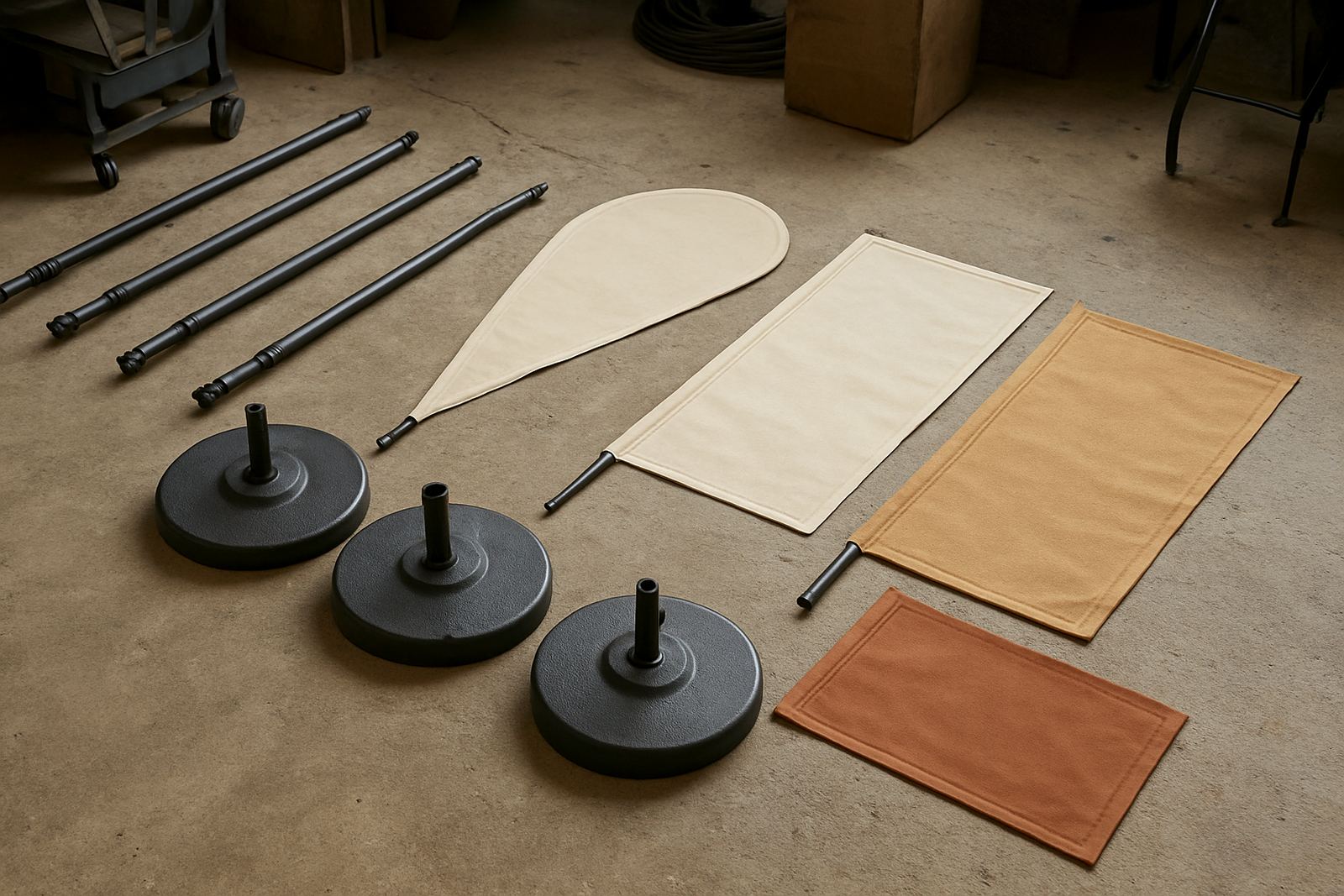
Feather flags and teardrop flags both work well for road frontage, promotions and wayfinding, but they behave differently. Feather flags have a straighter side profile and usually give a taller visual line. They work well when you want your message to be seen from a distance along a fence line or driveway. Teardrop flags have a curved top and stay neatly tensioned, which helps the graphic stay readable in gusty conditions.
If your branding uses long text, a feather layout usually gives a bit more usable space. If you want a neat, rounded profile for a compact site, teardrop can suit better. For schools and clinics where clear identification matters more than long wording, both styles can work if the message is kept short. The trick is not to cram too much copy onto the fabric, otherwise the flag becomes hard to read from a car or on foot.
- Choose feather for a taller, more vertical look.
- Choose teardrop for a tighter shape in windier spots.
- Keep text short: name, service and one callout is often enough.
- Use bold colour contrast for better visibility in daylight.
Match the base to the ground and the traffic
The base is just as important as the flag itself. A flag on paving outside a showroom needs a different stand from one on grass at a sports day or on compacted gravel at a mine access point. If the base is too light, the flag can swing too much or tip in a strong breeze. If it is too bulky, it may create a trip risk near an entrance.
For indoor displays, a flat base is often the simplest option. For outdoor pavement use, a water-filled or weighted base can help hold the pole steady. On soft ground, a spike base is often more practical. For temporary activations at schools, churches or trade days, it helps to have a base that can be moved quickly, especially when the weather changes or load-shedding affects evening setup times.
- Flat base for hard floors and indoor receptions.
- Spike base for grass and soil.
- Weighted base for paving, tar and high-traffic areas.
- Water-fill options help when extra weight is needed onsite.
Printing details that affect how long the flag lasts
Flag fabric must handle sun, dust and repeated handling. In Rustenburg and across Bojanala, that means the print should stay readable after long hours outdoors and regular packing away. Good artwork setup matters because very thin lines, pale text and small logos can disappear once printed on fabric. If the design uses gradients or tiny type, ask how it will look once the flag is moving in the wind.
Also think about finishing. Reinforced edges, neat stitching and strong pole sleeves help the flag stay in use for longer. When a flag is being moved often between sites such as Tlhabane, Mogwase and Kroondal, the seams take strain from folding and transport. A practical layout with the right hem and sleeve can save money later because the flag does not need replacing so soon.
For businesses operating during load-shedding or after-hours events, keep the artwork simple enough to read in low light or from headlights. A flag is not a billboard, so the message needs to work quickly.
How to buy for a school, mine or business entrance
Different sites need different buying choices. A school may need several flags for sports day, fundraisers and gate branding, while a mine site may want a more formal entrance display with clear site identification. Retailers and offices often want a neat branded point at the door, parking area or roadside turn-off. Think about whether you need one flag for a single venue or a small set for multiple branches.
Ask these questions before placing the order:
- Will the flag stay up all day or only for events?
- Do we need one design for all branches or site-specific wording?
- Will it be used near vehicles, pedestrians or both?
- Is there storage space for poles, bases and spare fabric?
If the flag is for a public-facing site, check local site rules and municipal requirements for placement. A display that blocks sightlines, walkways or access points can cause problems, especially at entrances with taxis, delivery vans or service vehicles.
A quick checklist before ordering event flags
A clean order starts with the right measurements and artwork. If you have a logo in the wrong format, small details may print poorly. If you do not know the pole height or base type, the flag may not fit the space. Having the right details ready also speeds up production and delivery across Rustenburg, Boshoek, Mooinooi and nearby towns.
- Confirm the venue: indoor, outdoor or both.
- Measure the space and note any height limits.
- Choose feather or teardrop based on visibility and wind.
- Select the correct base for paving, grass or a temporary event.
- Prepare your logo, wording and brand colours.
- Decide whether you need one flag or a set for multiple locations.
- Plan where the flag will be stored between uses.
If you are not sure, it is better to ask before production starts. A few minutes spent on the plan can prevent a flag that is too tall, too light or too busy to read. That saves time, money and unnecessary rework.
Where Crystal Clear Printing helps with the process
From Rustenburg CBD, our team supports mines, schools and businesses across Bojanala with flag printing, artwork setup, banner finishing, delivery and setup. Our team handles the practical side of the job, from design and print preparation through to fitting the right base and getting the flag in place. If you need the flag to match other branding on vehicles, gazebos, stationery or signage, we can keep the look consistent across the site.
For clients in Rustenburg Printing, Tlhabane Supply, Phokeng Supply, Kroondal Supply, Boshoek Supply, Marikana Supply, Mooinooi Supply and Mogwase Supply, the best starting point is usually the site and the purpose. Once those are clear, choosing the right flag becomes much easier. A well matched flag does its job quietly it catches the eye, points people in the right direction and holds up through day to day use.